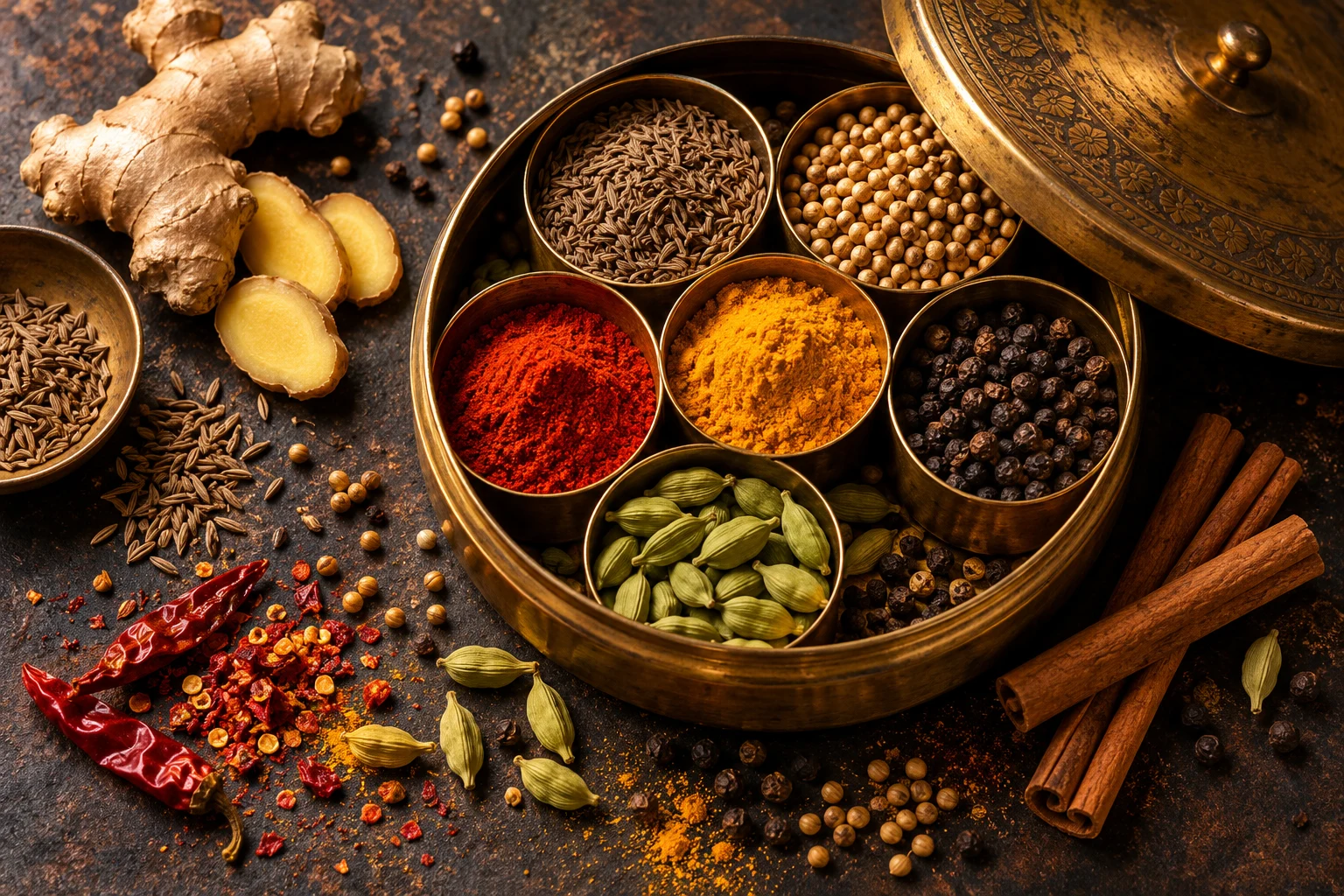
Some kitchen memories arrive before the food does. A lid lifts, a pan warms, and a familiar fragrance fills the room. A spice blend can become part of that memory: something you recognise, something you adjust, something you eventually pass on. Making your own masala is a lovely way to begin paying attention.
Every kitchen gets a say
In Indian Cookery, Madhur Jaffrey describes regional variations in garam masala and the family recipes found in North Indian and Pakistani homes. Her own choice is revealing: she favours green cardamom over black for its more delicate taste. That small preference tells a generous story about room for individuality within a tradition. Read Jaffrey’s introduction to garam masala.
For your kitchen, begin with the meal you want to eat. A blend for something creamy might invite one direction; a blend for vegetables or a hearty pot of beans might invite another. Think about the people around the table, too. The version worth keeping is the one you enjoy cooking with again.
Warmth has more than one meaning
In conversation with The Splendid Table, Jaffrey explains garam masala through traditional ideas of heating and cooling, naming aromatic spices such as cinnamon, pepper and cardamom. She is describing a cultural understanding of food. In this context, “warming” carries more meaning than the burning sensation of chilli or the temperature of a dish. Listen to her explanation.
Ayurveda offers another vocabulary for exploring food. AYUSH’s account describes six tastes: sweet, sour, salty, pungent, bitter and astringent. Within that traditional framework, rasa concerns taste, guna qualities and virya potency. These are distinct concepts, which a simple mild-to-hot scale cannot capture. Explore AYUSH’s introduction to the principles.
We share that context as part of the cultural story of spices. It does not establish one ancient garam masala formula or a health effect for your blend. Our own suggestions are about flavour and cooking.
Make the next spoonful yours
Try our Your Masala experience for a personal starting point. Think about the fragrances you enjoy and the kind of food you want to cook. Take the suggested blend into your kitchen as an experiment, with plenty of room to make it your own.
Keep a short note of the quantities you use and the dish you try them in. Next time, change one thing. Perhaps you want a little more of a fragrant note, or a gentler finish. Tasting two versions in the same dish makes the difference easier to notice than changing everything at once.
Make it a conversation at the table. Ask what people notice before telling them what you changed. Someone might describe a fragrance as sweet, someone else as comforting, and someone else might remember a dish from home. Those impressions are useful even when they disagree. You are learning about the people you cook for as much as the contents of the jar. Leave a little space in your notebook for their words.